About this event
In November, the International Road Federation (IRF) releases Roadmaps for Change: Green Roads at its Annual Conference in Geneva. The roadmap sets four outcomes for 2035: decarbonisation, climate resilience, circularity and nature.
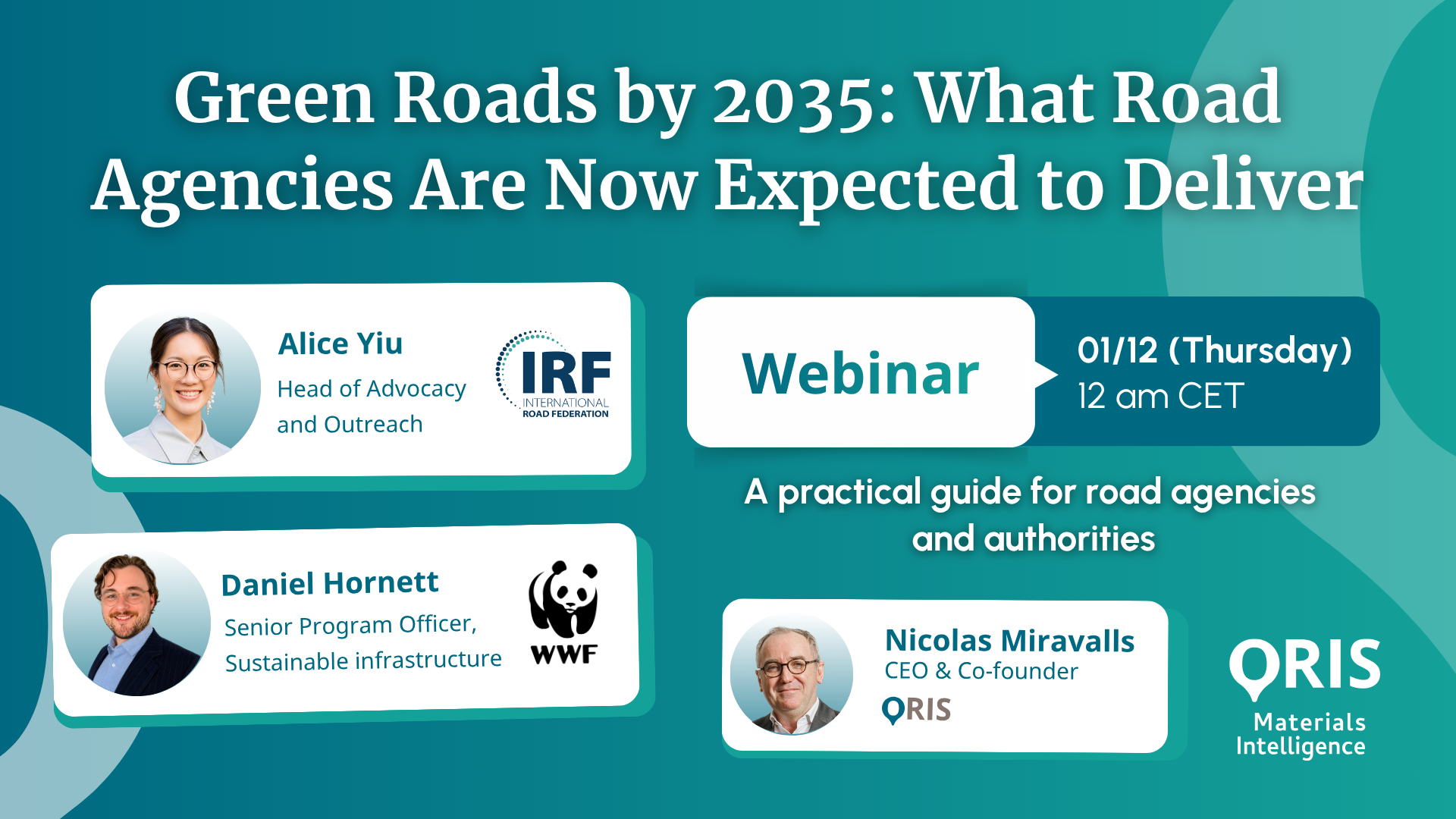
It is a practical guide for road agencies and authorities on what to do between now and 2035, written by IRF, WWF and ORIS with a global task force of partners.
This session is made for road agencies who want to act on it: what it asks of an agency, what to put in a tender, and where to start.
Why it matters
Roads carry their own carbon before a single vehicle drives on them. About 1% of global greenhouse gas emissions come from the materials used to build and maintain road and rail infrastructure. And 71% of those embodied emissions are locked into roads that already exist.
Climate hazards cost far more than the repair bill: indirect costs to the economy are on average 7.4 times the direct damage to road and rail assets. And three in four of the world's Key Biodiversity Areas already contain roads.
Road agencies are being asked to answer all of this at once. Most do not lack ambition, but more often a clear plan: what to do first, what to write into a tender, and how to show progress.
What You'll Learn
What a green road means in practice, and the four outcomes agencies are asked to reach by 2035
Where an agency has real control: the roadmap's three boundaries (what you directly control, what you shape with others, what you only influence)
What to do at each project stage, from before the project begins to design, procurement and construction, and operations and maintenance
How to turn a target into a tender requirement: carbon assessment at project preparation, shadow carbon pricing, and bonus/malus tied to verified results
How to check where your agency stands:
- The self-assessment checklist
- The 4-step path (baseline, pilot, scale, institutionalise)
- The capability stages (foundation, integration, optimisation)
Session Format
- 15 min: why this Decade matters and what IRF and its partners have committed to (IRF)
- 20 min: concrete recommendations for road authorities (WWF and ORIS)
- 15 min: from recommendation to practice, a practitioner's view
- 10 min: audience Q&A, with the self-assessment as your first step
New to the UN Decade?
The UN Decade of Sustainable Transport (2026 to 2035) is a ten-year programme, proclaimed by the UN General Assembly, to strengthen the sustainability of all modes of transport. Roads are central to it, because most transport systems rest on them.
Roadmaps for Change is IRF's series of four guides, one for each theme: inclusive, safe, green and efficient roads. This session covers the green one.
A green road is one that is planned, designed, built, operated and maintained to do four things: cut emissions and resource use over its whole life, stay safe and working under today's and tomorrow's climate, avoid harm to nature (and restore it where possible), and support low-carbon mobility. Safety and performance standards come first. They are never traded away.
By 2035, the roadmap asks agencies to reach four outcomes:
- Decarbonisation (less carbon in how roads are built and run)
- Climate resilience (roads that keep working when floods, heat and storms hit)
- Circularity (reuse and recycle materials instead of digging up new ones)
- Nature (plan routes so roads avoid damaging ecosystems)
Why it is the agency's job: it is not a separate environmental duty. It is asset performance, safety, access continuity, maintenance cost, risk and value for money, judged over the whole life of the road instead of the day it opens.
Who Should Attend
- Directors of Highways, Programme Directors and Heads of Infrastructure at road agencies and authorities
- Heads of asset management, network planning, procurement, and standards/policy at road agencies, road companies & concessionaires
- Sustainability, environment and climate-resilience leads inside road agencies
- Sustainability Directors, Carbon Managers, Net Zero Leads and Climate Resilience Engineers at the consultancies that advise agencies
- Infrastructure, climate and safeguards specialists at development banks and funds
- Anyone who has been asked to "align with the UN Decade" and wants to know what that means!
Hosted by
-
External speaker
Alice Yiu Head of Advocacy and Outreach @ International Road Federation (IRF)E
Alice leads advocacy and outreach at the IRF, the Geneva-based federation of the world's road transport ecosystem, and co-authored the Green Roads roadmap.
-
Team member
Nicolas Miravalls CEO @ ORIST
Nicolas Miravalls is a seasoned infrastructure leader with over 30 years of international experience spanning civil engineering, contracting, and strategic business development. As CEO and co-founder of ORIS, he is transforming infrastructure project design towards more sustainability, using data-driven insights and advanced digitalisation.
-
External speaker
Daniel Hornett Senior Program Officer, Sustainable Infrastructure @ WWFE
Daniel co-authored the roadmap, which includes a WWF-led section on nature. WWF also leads the GRID programme on greening transport infrastructure.

ORIS
Materials IntelligenceORIS combines senior expertise with advanced technology to help infrastructure teams measure and reduce carbon, cost and resource use, report with confidence, and adapt to climate risk, from a single linear infrastructure project to an entire portfolio.
